









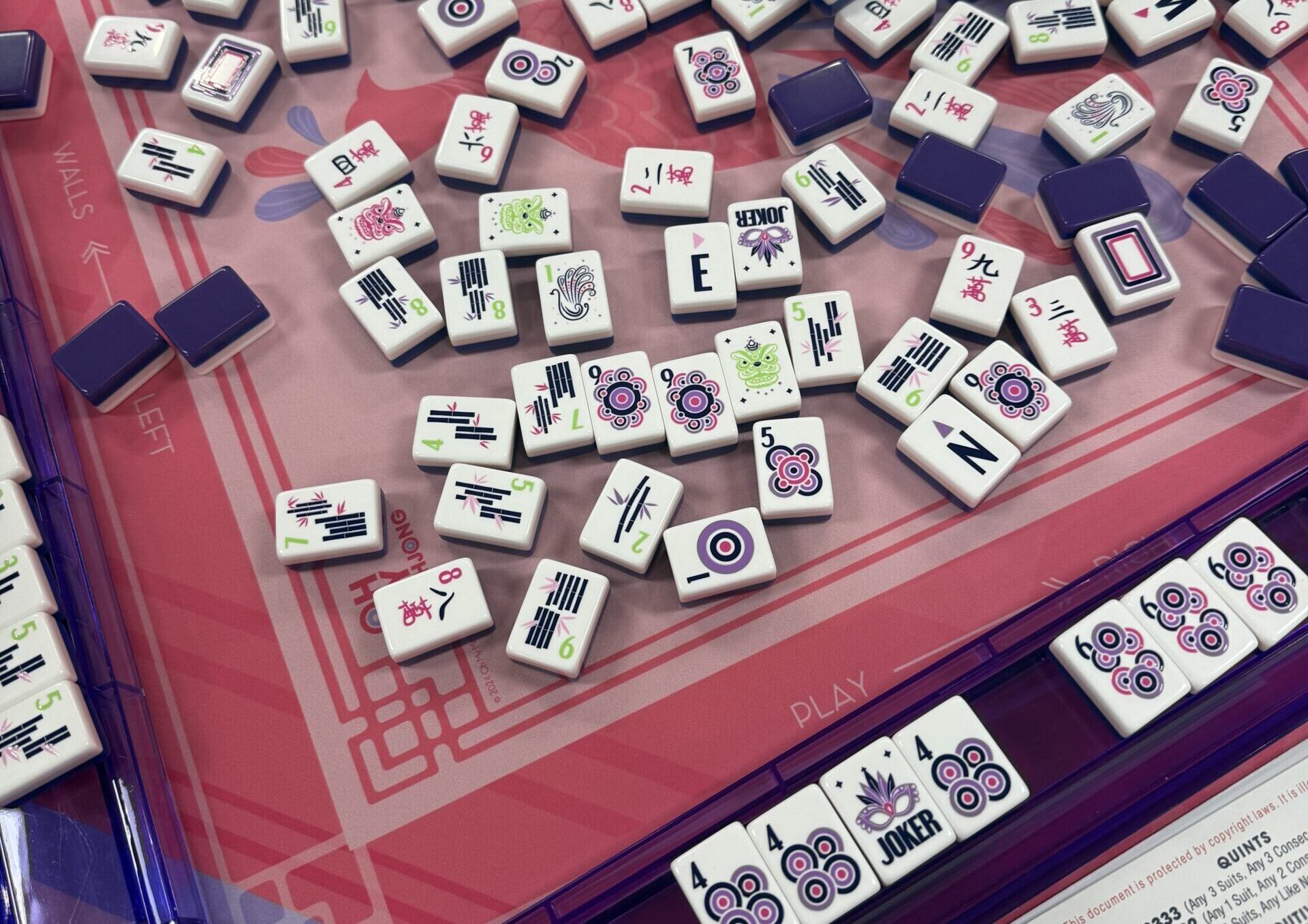
 Mahjong is a game I’d been curious about for a while. When I saw a local beginner class nearby, I jumped at the chance to see what it was all about. I signed up not knowing much beyond the pretty tiles, but a few hours later, I understood why this centuries-old game has quietly become a modern favorite again.
A Brief History
Mahjong originated in China during the Qing dynasty in the 1800s. The name means “sparrow,” said to describe the soft clicking sound the tiles make during play. The game made its way to the U.S. in the 1920s, when it became a fashionable pastime. Over the years, regional variations evolved – Chinese, Japanese, and American – all with slight differences in scoring and structure. What has stayed constant is the spirit of the game: connection, conversation, and a shared rhythm around the table.

My First Mahjong Class
My first American Mahjong class was taught by Katie Tipton, a certified instructor and owner of Knox Tiles. It was a small, friendly group with colorful tiles and plenty of laughter. Katie began by introducing the suits – bamboo, circles, and characters – along with the winds and dragons. She also explained the annual Mahjong card, which shows the combinations of tiles you can build, and a few other key parts of the game.
The first round, I felt completely clueless, but soon it clicked. I had a great group at my table, and we helped each other through it. It’s a fun way to socialize, it’s strategic without being stressful, and best of all, there are no screens in sight.
How to Learn Mahjong
If you’re curious to try, here are a few tips:
- Take a class: Look for a beginner Mahjong session locally. Learning in person makes it click faster.
- Get a starter set: You don’t need anything elaborate. Modern acrylic or resin sets are easy to find online or at specialty shops.
- Play slowly: Focus on learning the rhythm and sequence rather than winning. The rest comes naturally.
- Play frequently: Once you’ve learned the basics, the best thing you can do is simply play often. Mahjong has layers that start to make sense only through repetition. Don’t worry about strategy at first; focus on recognizing patterns and understanding the flow of a round.
A Few Key Terms in American Mahjong
Tiles: The 152 pieces used to play. American Mahjong adds eight Jokers and Flowers beyond the standard 144-tile Chinese set.
Suits: The main numbered categories:
- Bams (Bamboo): green sticks or stalks
- Dots (Circles): round patterns
- Cracks (Characters): Chinese characters representing numbers
Honors: Special tiles that include Winds (East, South, West, North) and Dragons (Red, Green, White).
Flowers & Seasons: Bonus tiles worth extra points; sometimes used to complete special hands.
Pair: Two identical tiles; every winning hand must include one.
Quint: A set of five tiles, used only in special hands.
Joker: A wild tile that can stand in for any tile in a Pung, Kong, or Quint.
Charleston: A signature American Mahjong feature: a tile-passing phase before each round begins, where players exchange tiles to improve their hands.
Card (NMJL Card): The annual card issued by the National Mah Jongg League, listing all valid hands and point values for that year. Most players keep one beside them during play.
Wall: The stacked rows of tiles from which players draw during the game.
Mahjong: Declared when a player completes a valid hand from the NMJL card and wins the round.